
AI is rebuilding engineering teams in real time: here’s what’s actually happening
Two years ago Klarna’s CEO went on stage and announced that AI had replaced 700 customer-service jobs at the company. This was the future, he said. This is how companies will operate now.
Then in May 2025 Klarna quietly started rehiring those positions. A few months later the CEO actually said why, out loud, on the record: “Cost unfortunately seems to have been a too predominant evaluation factor… what you end up having is lower quality.”
So a sitting CEO admits in public that the AI-first headcount plan did not work. Eighteen months of “AI is replacing humans,” walked back in a single sentence.
Yes, Klarna is about customer service, not software engineering. But it is the clearest sign yet that the headcount math companies have been telling themselves for two years falls apart the moment it meets reality. And what already happened in customer support is starting to happen in engineering teams too. Slower, quieter, harder to spot on a chart, but moving the same way.
Last month I wrote about why the unit economics of AI today are broken. This is the other half of that story: what AI is doing to engineering teams right now. The shape is changing fast, junior hiring is falling off a cliff, whole role categories are getting absorbed, and the senior IC job is shifting in ways a lot of seniors have not caught up with yet. I will be blunt, I will show you the data, and you can draw your own conclusions.
The numbers nobody is showing the board
Forget the CEO quotes and the LinkedIn thinkpieces for a second and look at the actual hiring data.
Indeed Hiring Lab’s April 2026 labour market snapshot shows US software-development postings still sitting around 28% below the February 2020 baseline. That is a recovery from the worst of the trough, but it is nowhere near pre-pandemic levels. Meanwhile AI-related postings have climbed to 5.4% of all listings, past the old 3.3% peak from 2022. So it is not simply “fewer jobs.” It is that the handful of jobs actually opening are heavily skewed toward AI work.
The US Bureau of Labor Statistics tells the same story from another angle. The smaller “Computer Programmer” category dropped 27.5% between 2023 and 2025, while the much larger “Software Developer” category barely moved (-0.3%). The pain is concentrated in the entry-level and mid-level “Programmer” titles, not in the senior developers.
Stanford’s 2026 AI Index adds the part that should worry you most. Software-developer employment among 22 to 25 year olds has fallen nearly 20% since 2024. As far as I can tell that is the first white-collar job category where you can actually measure AI dragging down entry-level numbers.
A 2025 LeadDev survey found 54% of engineering leaders expect junior hiring to decline long term because of AI, even though only 18% planned to cut junior hiring in the coming year. That gap is leaders saying the quiet part out loud while not yet acting on it.
Now flip to the other side of the ledger. Forward-Deployed Engineer postings, a role Palantir pioneered that is now standard at OpenAI, Anthropic and Cohere, went from 643 in April 2025 to 5,330 in April 2026. That is a 729% jump in a single year, with Google and Deloitte alone making up roughly 40% of the openings. Lightcast’s March 2026 GenAI job market update tracks around 10,000 unique GenAI-skill postings a month, and LinkedIn has AI Engineer as the fastest-growing role for young workers two years running. On top of that, Forrester’s 2026 Predictions expect a 20% drop in CS enrollments going forward, so the pipeline that was supposed to feed those entry-level jobs is shrinking too.
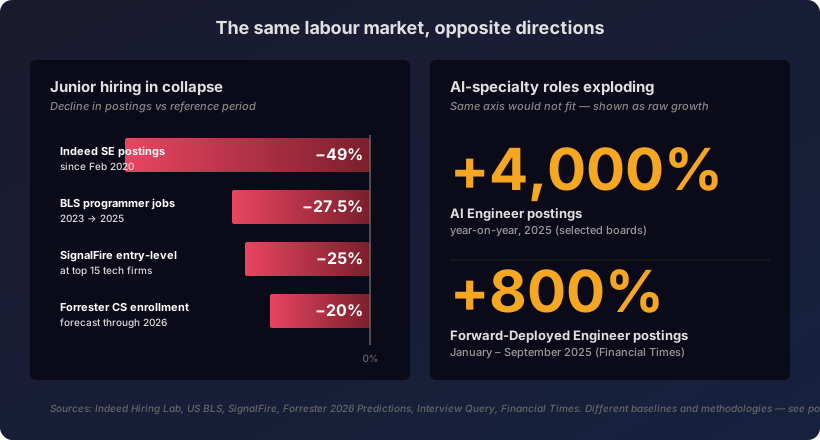
Put it together and the picture is pretty clear. The junior side is collapsing, AI-specialty roles are exploding while total hiring shrinks, and the middle just sits there flat. Nobody is rushing to put this on a slide when they pitch their AI strategy to the board. The story the board is supposed to hear is that AI helps engineers do more. Not that it is quietly being used as a reason to stop hiring juniors at all.
Smaller teams, more senior, and more fragile
The team that comes out of this is smaller and more senior, it is supposedly faster, and by most accounts it is also a lot more fragile.
Look at what the big names are actually doing. Shopify made AI usage a baseline expectation. It shows up in performance reviews, and teams have to prove a job cannot be done by AI before they are allowed to backfill it. Shopify’s VP of Engineering Farhan Thawar reports something like a 20% productivity gain and leans on weekly demos as the real velocity signal instead of PR counts. Stripe runs an “Experimental Projects Team,” roughly two dozen senior engineers driving fleets of agents through an internal harness they call “Minions.” Google’s Pichai said in April 2026 that “75% of new code at Google is AI-generated”. Take the exact number with a pinch of salt, but the direction is not in doubt. Back in April 2025 Microsoft’s Nadella put 20-30% of the code in some Microsoft projects in the AI-written column.
Same pattern everywhere you look: smaller pods, more senior on average, AI plumbing baked into how the team works. Anthropic’s 2026 Agentic Coding Trends Report calls this dynamic surge staffing, where specialists get pulled onto a problem for a short burst rather than sitting on a permanent roster. The modern engineering team is starting to look less like a product team and more like a Big Four consulting bench.
And here is the bit almost nobody puts on the slide. A team shaped like this is brittle. Fewer people understand how the whole system fits together, there is less long-tenure knowledge in the room, and you lose most of that messy back-and-forth between juniors and seniors that used to grow the next layer of seniors. Faros AI’s 2026 telemetry covering 22,000 developers and more than 4,000 teams has a name for it: “Acceleration Whiplash.”
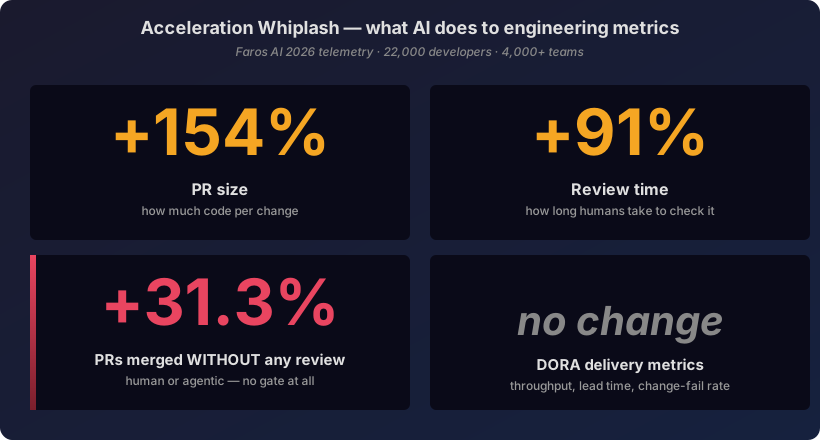
Teams ship more code, review less of it, and then take longer to review the part they did not skip. That is the kind of efficiency that looks great on a slide and miserable on a Friday afternoon.
The roles, growing and absorbed
Hiring overall is down, but a few specific roles are exploding. So which ones? The chart shows the shape, and here is what sits behind each label.
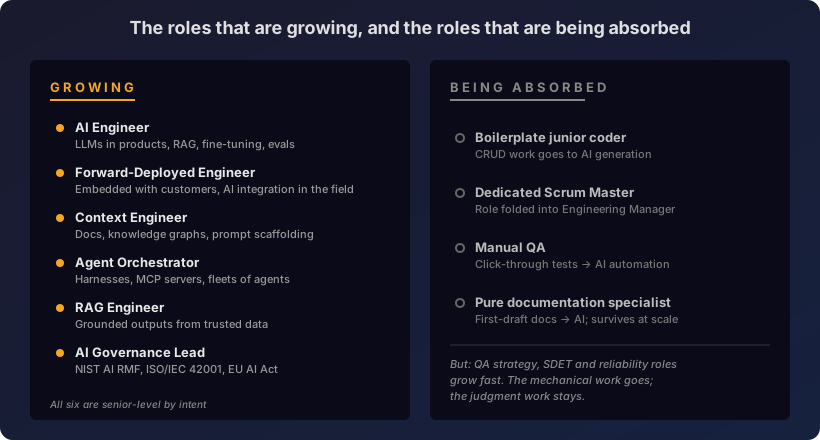
Six roles are growing, and every one of them is senior by design:
- AI Engineer. Wires LLMs into products: prompts, RAG, fine-tuning, evals. Roughly 80% of the postings are senior-level. UK salaries run £110-180K, US higher.
- Forward-Deployed Engineer (FDE). Palantir invented it, now OpenAI, Anthropic and Cohere all hire for it. You sit with the customer and turn raw AI capability into something that survives production.
- Context Engineer. A discipline you see at Stripe, Shopify and ThoughtWorks. They own the documentation, knowledge graphs and prompt scaffolding that make agents behave inside one specific organisation.
- Agent Orchestrator. Builds the harnesses, MCP servers and feedback loops for running fleets of agents in parallel. Simon Willison calls this vibe engineering.
- RAG Engineer. Keeps outputs grounded in sources you actually trust. This is your main defence against hallucination, and every regulated industry is hiring for it.
- AI Governance Lead. NIST AI RMF, ISO/IEC 42001, the EU AI Act, OWASP Top 10 for Agentic Apps. This used to be a corner of the security team. Now it is its own job.
The old career advice was “get to senior in about five years, then pick a specialism.” That does not work anymore. Now you specialise in one of these while you are climbing to senior, because the market will not wait for you to do it in sequence.
And four roles are getting absorbed:
- Boilerplate junior coding. The CRUD grind that used to be how first-year juniors learned the codebase. AI does it for nothing compared to a junior salary.
- Dedicated Scrum Master. At small and mid-sized companies this is quietly folding into the Engineering Manager’s job.
- Manual QA. Click-through testing is going to AI test automation. Indeed cut its dedicated QA Engineer roles back in March 2023 and reportedly watched test quality slip afterward, which should tell you something.
- Pure documentation specialist. The first draft goes to AI now. The role hangs on at big companies but has drifted toward content strategy and DevEx.
Note that QA as a strategy is growing fast. Tesla took its QA team from 260 to 390 between 2020 and 2025, and SDETs and reliability engineers are some of the fastest-growing roles going into 2026. The repetitive clicking disappears, the judgment work stays.
And to be clear, none of this is a knock on the people doing these jobs today. The shift is real and it is fast, and pretending otherwise helps nobody.
The skill bar is moving up
The bar is going up at every level, so let me go level by level.
Juniors now need on day one what they used to pick up in their second year: computational thinking, judgment in code review, the ability to actually deploy to production, and real fluency with AI tools. The fastest way to upgrade your CV right now is to deploy something real and keep it running for six months. Stack Overflow’s 2025 survey has 84% of developers using AI tools, so being good with them is the price of entry, not the thing that sets you apart. Writing boilerplate, basic debugging, knowing your syntax cold: still required, just nowhere near enough on its own.
Mid-level engineers are getting squeezed the hardest. Raw implementation throughput used to be your edge, and now it is cheap. What matters now is implementation judgment: writing a precise spec, supervising the agents, refactoring without making a mess, knowing when to overrule the machine. Kent Beck nailed it: “today’s AI assistants lack taste.” More and more, your job in the middle is to be the taste in the room. The people who do not make that jump tend to plateau, and it is weirdly hard to put your finger on why.
Senior, staff and principal engineers move away from depth of implementation toward architecture, judgment, and reviewing other people’s (and other agents’) work at scale. Simon Willison’s vibe engineering essay lays it out: “researching approaches, deciding on high-level architecture, writing specifications, defining success criteria, designing agentic loops, planning QA, managing a growing army of weird digital interns who will absolutely cheat if you give them a chance, and spending so much time on code review.” If your whole senior identity is “I can code anything,” you are now competing with AI. If it is “I know what actually matters in this specific company,” AI just makes you stronger.
Engineering managers picked up a few new headaches nobody warned them about. One is token economics, because an engineer can quietly burn $1,000+ a month on tokens with nobody approving it, and you want to be on top of that before finance is. Another is metrics: lines, PR counts and AI acceptance rates are all gameable now, but a weekly demo is not. The third is hiring, because whiteboarding is dead and the useful interview is live debugging and reading an AI-generated PR together.
CTOs and VPs of Engineering have their own version of this at the strategy level. There is platform thinking, where DORA’s January 2026 ROI report frames AI as an amplifier of whatever engineering quality you already have, which means platform quality maps directly onto how much value you get out of AI, so do not let your CFO write platform investment off as overhead. There is compliance, where NIST AI RMF, ISO/IEC 42001 and the EU AI Act stopped being optional somewhere in 2026. And there is talent-pipeline strategy, which deserves its own section, so here it is.
The pipeline trap
This is the part I would tattoo on a whiteboard if I could.
Stack Overflow’s blog said it flatly in late 2025: “if you don’t hire junior developers, you’ll someday never have senior developers.”
The trap is structural, and it is delayed. The juniors you skip in 2026 are exactly the seniors you will not have in 2031. By the time that hole is obvious on the org chart, you cannot fix it inside the same hiring cycle, because you cannot manufacture five years of experience on demand.
Right now tech leadership splits into two camps on this.
Camp A is Anthropic’s Dario Amodei, who reckons up to 50% of entry-level white-collar jobs could be gone within five years. Treat that as a forecast rather than a measurement, but it is clearly the camp driving the headcount decisions you can already see in the data above.
Camp B is GitHub’s Thomas Dohmke and Google’s Sundar Pichai, who argue AI makes juniors more valuable because it multiplies what one person can ship. GitHub kept hiring early-career engineers right through 2025. Pichai has said Google wants to hire more engineers precisely because AI is making them more productive. And IBM just tripled its entry-level hiring in 2026, with CHRO Nickle LaMoreaux openly describing those extra juniors as the human oversight layer their AI investments need, including for the work “AI can do.”
Both camps are staring at the same data and walking away with opposite answers, because they are placing different bets. The honest position is that we do not yet know which bet pays off. What we do know is that the cost of guessing wrong is lopsided. Guess wrong with Camp A and you hit 2031 with a senior shortage you cannot hire your way out of. Guess wrong with Camp B and you carried a bit more headcount cost in 2026, which you can trim whenever you like.
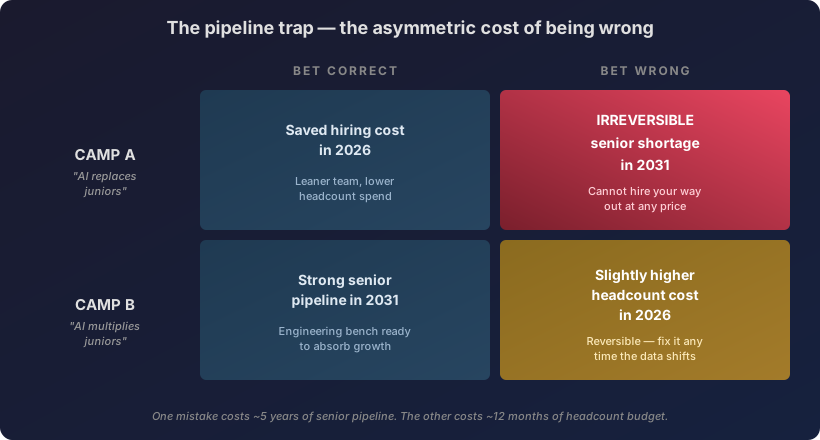
One of those mistakes you can undo. The other one you cannot.
So if you run an engineering org, the takeaway is not complicated. Do not freeze junior hiring outright. Slow it down, rebuild it around AI-augmented work, push up what you expect a junior to handle, but do not take it to zero. Get this right in 2026 and you will be very glad you did when 2031 shows up.
What I tell clients
So here is what I actually tell engineering leaders, on pretty much every project where this comes up.
- Keep hiring juniors. Just hire fewer of them, and rebuild their first six months. The old “write CRUD until you understand the codebase” first year is gone. Swap it for reviewing AI-generated PRs, getting something small deployed and running in production by month three, and being the person who can explain how an agent went off the rails. A junior who comes out of that program after two years is more useful than a junior from five years ago, not less.
- Put token budgets on teams or features, and make them observable. Tag every AI resource with cost-center, project, environment and owner. Skip that and the AI bill turns into one fat line item nobody can question. Leave it wide open and your engineers will each run through $1,000+ a month, easily.
- Drop PR-count and line-count metrics and switch to weekly demos. Activity metrics are gameable in ways they simply were not three years ago. Anyone can fire off a hundred PRs of AI-generated boilerplate now. You cannot fake a working demo the same way.
- Enforce an explainability rule. I steal Simon Willison’s golden rule here: “I won’t commit any code to my repository if I couldn’t explain exactly what it does to somebody else.” Make it policy across the org. If an engineer cannot explain it at review, it does not merge. This one rule heads off most of the worst AI-coding disasters I have watched happen, including the Cursor-Claude agent that wiped PocketOS’s production database in nine seconds last month, where nobody was in a position to stop the destructive command before it ran.
- Write down the team you would build if you were starting from scratch today, not the team you happen to have. Then plan two years of hiring toward that gap instead of just backfilling whoever leaves. It is the single highest-payoff afternoon an engineering leader can spend in 2026.
Build the team you want to be running in 2031
So that is where we are. AI is reshaping engineering teams while we watch, into something smaller, more senior, more dependent on a handful of specialists at the top of the stack, and noticeably more brittle than what came before. No single company is going to reverse that on its own. It runs on the same economics I wrote about last month, and it will keep heading this way whether or not your org chart is ready for it.
What you do get to decide is what you do this year. Hire some juniors and actually rethink how you onboard them. Pay your senior people for judgment instead of raw output. Tag every AI resource you spin up. Demo the work every week. And tell your team the truth about all of it, because they can feel it already anyway.
Build the team you will want to be running in 2031, not the one your headcount spreadsheet defaults to in 2026.
I am curious where you land on this, especially if you are hiring junior developers right now (or pointedly not). Leave a comment.
Comments